Small Methods, Big Impact – Mini Facilitation Tools for Better Meetings
It does not always have to be a large workshop. Small, well-chosen methods are often enough to create a real breakthrough, even in a daily stand-up or a regular team meeting.
Here is a list of our favourite methods:
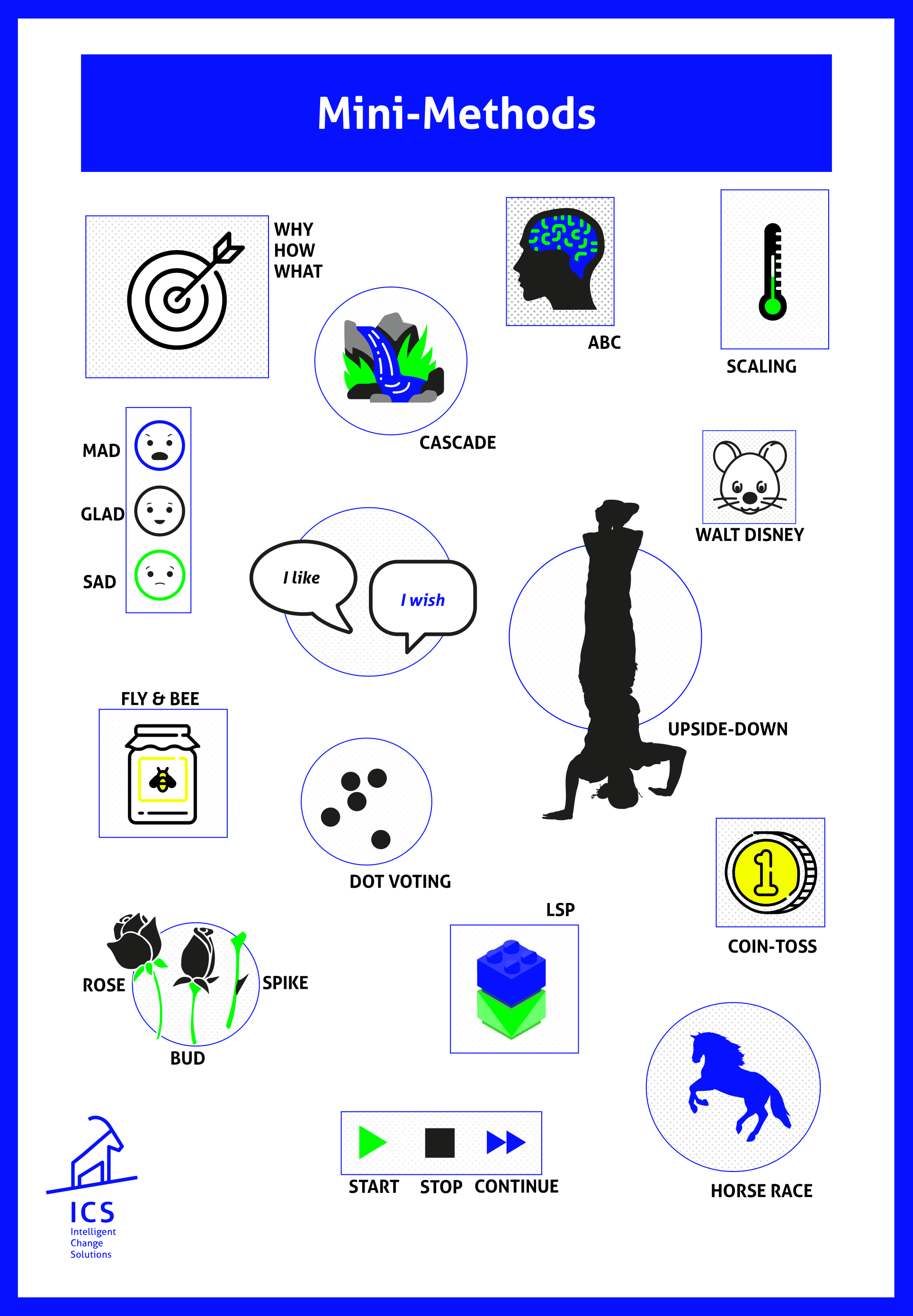
WHY HOW WHAT
First explain why something is important and what it is intended to achieve. Then discuss how it can be accomplished and, finally, what specifically needs to be done.
Toolbox: Golden Circle
Cascade
Move from the individual to the group. First, reflect individually, then in pairs, followed by small groups and finally in plenary with everyone.
ABC
ABC is a brainstorming method in which ideas are noted down for each letter of the alphabet.
Scaling Questions
Scaling questions help capture complex topics and emotions. On a scale from 0 to 10, how likely are you to use scaling questions?
Toolbox: Scaling Questions
Mad – Sad – Glad
Mad–Sad–Glad collects thoughts and statements in response to the following questions:
What sometimes makes me mad here?
What makes me sad?
What makes me glad?
Toolbox: Stages of Facilitation
Walt Disney Method
The Walt Disney Method is a creative problem-solving method based on three roles: the Dreamer, the Realist, and the Critic. These roles help teams generate ideas, assess their feasibility, and identify potential weaknesses in order to develop well-rounded solutions..
I Like – I Wish
I Like – I Wish is a quick team exercise:
What do I like about the way we work together?
What else would I like to see?
Toolbox: Stages of Facilitation
Reverse Brainstorming
Reverse Thinking is a paradoxical method that starts with the question: What are our best ideas for guaranteeing failure?
Toolbox: Stages of Facilitation
Fly & Bee
Simply change your focus. The bee flies to the flowers and towards places where things are flourishing. The fly flies to … and towards places where things stink.
Toolbox: Fly & Bee
Dot Voting
Voting procedures in groups can quickly lead to winner–loser dynamics. With dot voting, everyone receives several points that they can distribute among different options. This creates a more nuanced picture instead of black-and-white thinking.
Toolbox: Group Decision Taking
Coin Toss
Unable to make a decision, but still need to move forward? In such situations, a coin toss can help. Either the method creates clarity or it brings new arguments into the discussion.
Toolbox: Group Decision Taking
Rose – Bud – Thorn
As a team, we collect answers to the following questions:
What is already flourishing? Rose
What shows promise? Bud
Where are there still obstacles or sticking points? Thorn
Toolbox: Stages of Facilitation
LSP
LSP means thinking with your hands and gaining a tangible understanding of topics. In LEGO® SERIOUS PLAY®, we use LEGO® bricks to model challenges and solutions.
Here you will find the complete method explained in detail
Horse Race
Which topic should be given priority? Each team member may move three topics forward by one space—or one topic forward by three spaces. At the end, the topic with the highest priority wins..
Toolbox: Stages of Facilitation
Start – Stop – Continue
As a team, we collect answers to the following questions:
What do we need to start doing now to achieve the goal? Start
What should we stop doing from now on to achieve the goal? Stop
What should we continue doing to achieve the goal? Continue
Sometimes the method is extended with more/less:
What should we do more of?
What should we do less of?
Toolbox: Stages of Facilitation
Would you like to develop your team into a high-performance team in the long term? Then take a look at the Five (Dys)functions of a Team as well.
Toolbox: The Five Functions of a Team