The Key to Greater Effectiveness
Not everything that concerns us can be changed. The Circle of Influence shows where we can truly be effective – and how to use our energy in a targeted way.
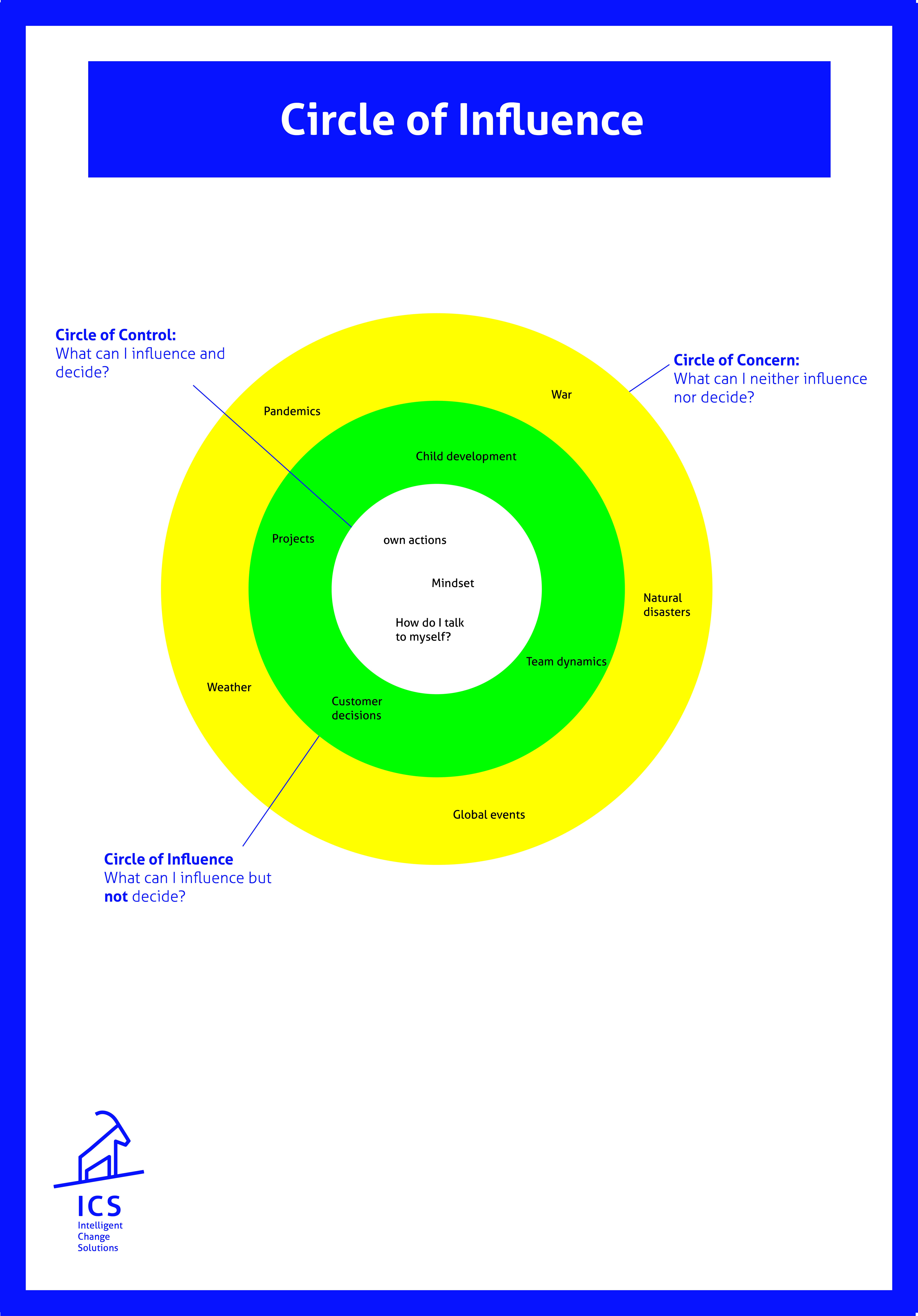
The Circle of Influence, introduced in Stephen R. Covey’s book “The 7 Habits of Highly Effective People,” is a simple yet highly effective model for consciously directing one’s focus. It helps distinguish between three areas:
What can I decide directly?
What can I influence, but not decide myself?
What lies completely outside my influence?
Especially in change processes, in everyday leadership, or in demanding team contexts, people often lose a great deal of energy on topics they can neither control nor change. The model creates clarity, strengthens self-efficacy, and directs attention to where action makes sense.
Circle of Influence: The Model of Three Levels of Action
The model distinguishes three circles:
1. Circle of Control
The Circle of Control includes everything I can directly manage, decide, or do myself.
This primarily includes one’s own actions, behavior, priorities within one’s area of responsibility, communication, and mindset.
This is where personal effectiveness is greatest, because direct action is possible.
2. Circle of Influence
The Circle of Influence includes topics that I can influence but not decide myself.
These include, for example:
Team dynamics
Projects
Decisions made by clients
The development of other people
Collaboration within the environment
In this area, influence works through communication, relationships, attitude, argumentation, role modeling, and thoughtful interventions.
3. Circle of Concern
The Circle of Concern includes topics that affect or concern me but over which I have neither direct influence nor decision-making power. These include, for example, the weather, pandemics, war, global events, natural disasters, fundamental external conditions, and also the past.
These issues can have a strong emotional impact, yet they largely lie outside our concrete scope of action.
The Key Distinction for Effective Action
The model makes it clear that not all topics should be treated equally.
In the Circle of Control, the focus is on responsibility and concrete action.
In the Circle of Influence, the focus is on relationships, communication, and targeted influence.
In the Circle of Concern, the focus is primarily on accepting reality and not losing one’s energy in helplessness.
Effective people and effective leaders primarily focus on the two inner circles
Where Effectiveness Is Lost – and How to Regain It
In stressful or dynamic situations, many people quickly shift into the outer circle:
They get frustrated about external conditions
They endlessly discuss decisions made by others
They focus on problems they cannot change
The result is often frustration, helplessness, blame, and exhaustion.
The model helps to bring the focus back: from the Circle of Concern to the Circle of Influence and, ideally, into the Circle of Control.
How to Deliberately Expand Your Influence
The three circles are not only a diagnostic tool but also a practical lever for development.
Those who act consistently within the Circle of Control and communicate effectively within the Circle of Influence increase their credibility, strengthen trust, and gradually expand their influence.
Influence does not arise from frustration, but from deliberate action.
How to Apply the Circle of Influence in Practice
In Change Processes
The model helps to concentrate energy:
What can we implement ourselves?
Where can we actively exert influence?
What must we accept, even if we do not like it?
This creates greater ability to act within change processes.
Helpful reflection questions include:
Which aspects of the change can we actively shape?
Where can we exert influence – even indirectly?
Which conditions must we accept?
Where are we currently losing unnecessary energy?
What would be a first concrete step within the Circle of Control?
How can we deliberately expand our influence as a team?
In Leadership
For leaders, the model is particularly helpful for making conversations productive:
What lies within your own area of responsibility?
What can you address or influence?
What lies outside your scope of action?
This strengthens personal responsibility and reduces dynamics of helplessness.
Concrete Impulses for Effective Leadership
Shift conversations away from pure problem orientation toward possible actions.
Help employees distinguish between control, influence, and concern.
Reinforce the question: What can we do concretely?
Use the model to promote responsibility without creating overload.
Make it visible that even small scope for action can create real effectiveness.
In Teams
Teams can use the model to structure discussions:
Which topics lie within our Control?
Where do we have Influence?
What is merely Concern?
This makes meetings clearer, more solution-oriented, and more focused.
Guiding questions for focused team discussions:
Which topics do we repeatedly discuss without being able to influence them?
Where do we as a team have real room for action?
Which topics clearly lie within our Control?
Where could we exert influence more actively instead of waiting?
How can we support each other in staying within the Circle of Influence?
Which decision can we make ourselves today?
For Individual Reflection
The model is highly suitable for strengthening self-leadership and gaining clarity in everyday life.
Especially in challenging situations, it helps to take a step back and consciously differentiate:
What can I do concretely?
Where can I exert influence?
What must I accept?
Typical reflection questions:
Which topics am I currently focusing on the most?
What of these lies within my Circle of Control?
Where do I have influence, even if I cannot decide myself?
Which topics actually belong in the Circle of Concern but still consume a lot of energy?
What do I regularly get upset about without changing anything?
What would be a concrete next step within my area of influence?
How would I act if I focused on what I can truly control?
The Circle of Influence as the Key to Effectiveness
The Circle of Influence is more than a conceptual model. It is a practical tool for self-leadership, leadership, and change.
It helps to
clarify focus,
use energy effectively,
strengthen responsibility, and
maintain self-efficacy even in complex situations.
Because not everything can be controlled. But it is almost always possible to decide where to direct our attention and where to take action.
Source
Stephen R. Covey: The 7 Habits of Highly Effective People