Recognizing and Improving Communication Patterns
Transactional Analysis (TA) describes how people typically communicate and which unconscious patterns shape their interactions. It is based on two central models.
1. The Structural Model – The Three Ego States of a Person
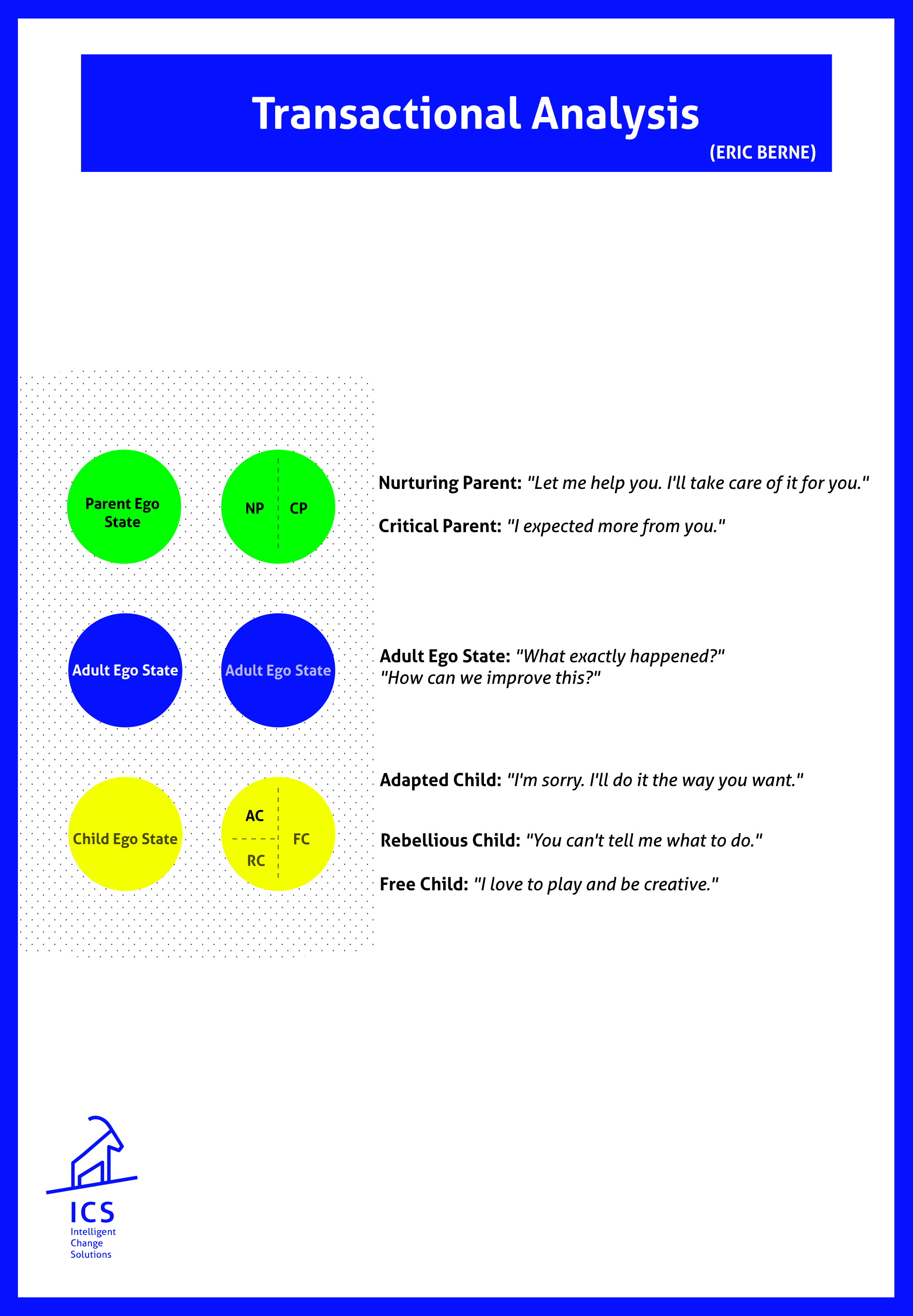
The structural model distinguishes between three central ego states that influence our thinking, feelings and behavior.
Parent Ego State: Contains norms, values and learned patterns from childhood that were adopted from caregivers.
Critical Parent Ego State: Judgmental, controlling, demanding.
Example: “Do it differently! This is not right!”Nurturing Parent Ego State: Supportive, protective, encouraging.
Example: “Oh, poor you, come on, I’ll help you with that.”
Adult Ego State: Acts rationally, objectively and in relation to the situation. Decisions are based on facts and logic.
Example: “What facts do we have, and what supports this decision?”
Child Ego State: Includes emotional and spontaneous reactions based on early childhood experiences.
Free Child Ego State: Creative, spontaneous, playful.
Example: “Cool, let’s try that out right away!”Adapted Child Ego State: Obedient or rebellious, reacts to expectations from authority figures.
o Compliant Adapted Child Ego State: Obedient, seeks approval.
Example: “I’ll do it because you say so.”
o Rebellious Child Ego State: Resistance, defiance.
Example: “No, no, no. I’m not doing that!”
The interaction of these ego states determines our communication behavior. Conscious reflection helps us conduct conversations more constructively.
The Functional Model – Communication Dynamics and Games
The functional model describes how these ego states interact in communication:
Parallel transactions — seemingly harmonious communication that can continue indefinitely:
The expectations of the people involved match. For example, the Parent Ego State speaks to the Child Ego State and receives the expected response.
Crossed transactions — potential for conflict or a deliberate interruption of a parallel transaction:
One person expects a certain reaction but receives an unexpected response.
Example with potential for conflict:
Person A speaks from the Adult Ego State:
“Could you please help me solve this problem?”Person B responds from the Rebellious Child Ego State:
“Why should I do that? That’s not my job!”Result: Communication stalls or escalates.
Example of a deliberate interruption of a parallel transaction:
Person A speaks from the Critical Parent Ego State:
“Do it differently! This is not right!”Person B responds from the Adult Ego State:
“I understand your concerns. Let’s look together at how it is described in the instruction manual.”Result: The expected parallel transaction between the Critical Parent Ego State and the presumed Rebellious Child Ego State is interrupted by the unexpected crossed transaction with the Adult Ego State. Ideally, this creates a new parallel transaction at the level of the Adult Ego State.
Psychological games — manipulative dynamics:
Recurring patterns in which roles are played unconsciously, such as victim, persecutor or rescuer. Examples:
The “Yes, but…” game:
A person appears to be looking for solutions but rejects every suggestion in order to remain in the victim role.The “Why does this always happen to me?” game:
The person unconsciously seeks confirmation of their helplessness.
Drama Triangle
The concepts of Transactional Analysis can be directly linked to the Drama Triangle. The roles in the Drama Triangle — victim, persecutor and rescuer — are reflected in specific ego states: the persecutor often acts from the Critical Parent Ego State, the victim from the Adapted Child Ego State and the rescuer from the Nurturing Parent Ego State.
When used consciously, Transactional Analysis helps identify these patterns and interrupt them through conscious communication, for example through crossed transactions or changed ego states.
How You Can Apply It in Coaching, Training and Facilitation
Coaching:
Helps clients recognize and consciously manage their own communication patterns.
Example: “Which ego state are you acting from right now?”Training:
Role plays allow participants to try out different ego states and develop empathy and flexibility. Participants can experience and reflect on different response patterns.Facilitation:
Observation and guidance of the conversation flow help prevent conflicts and misunderstandings. In the case of games, endless transactions or crossed transactions, the facilitator can intervene deliberately to restore a constructive communication climate.
Practical Examples
Team communication:
A meeting escalates because one person dominates from the Critical Parent Ego State. A conscious shift into the Adult Ego State improves the exchange.Conflict resolution:
An employee responds to constructive criticism from the Adapted Child Ego State by withdrawing. Targeted questions help guide them into the Adult Ego State.Leadership:
A manager reflects on their communication behavior and recognizes when they unconsciously act in an overprotective way from the Nurturing Parent Ego State. By consciously shifting into the Adult Ego State, they encourage personal responsibility within the team.
Transactional Analysis offers a valuable method for recognizing and understanding communication patterns and shaping relationships more consciously.