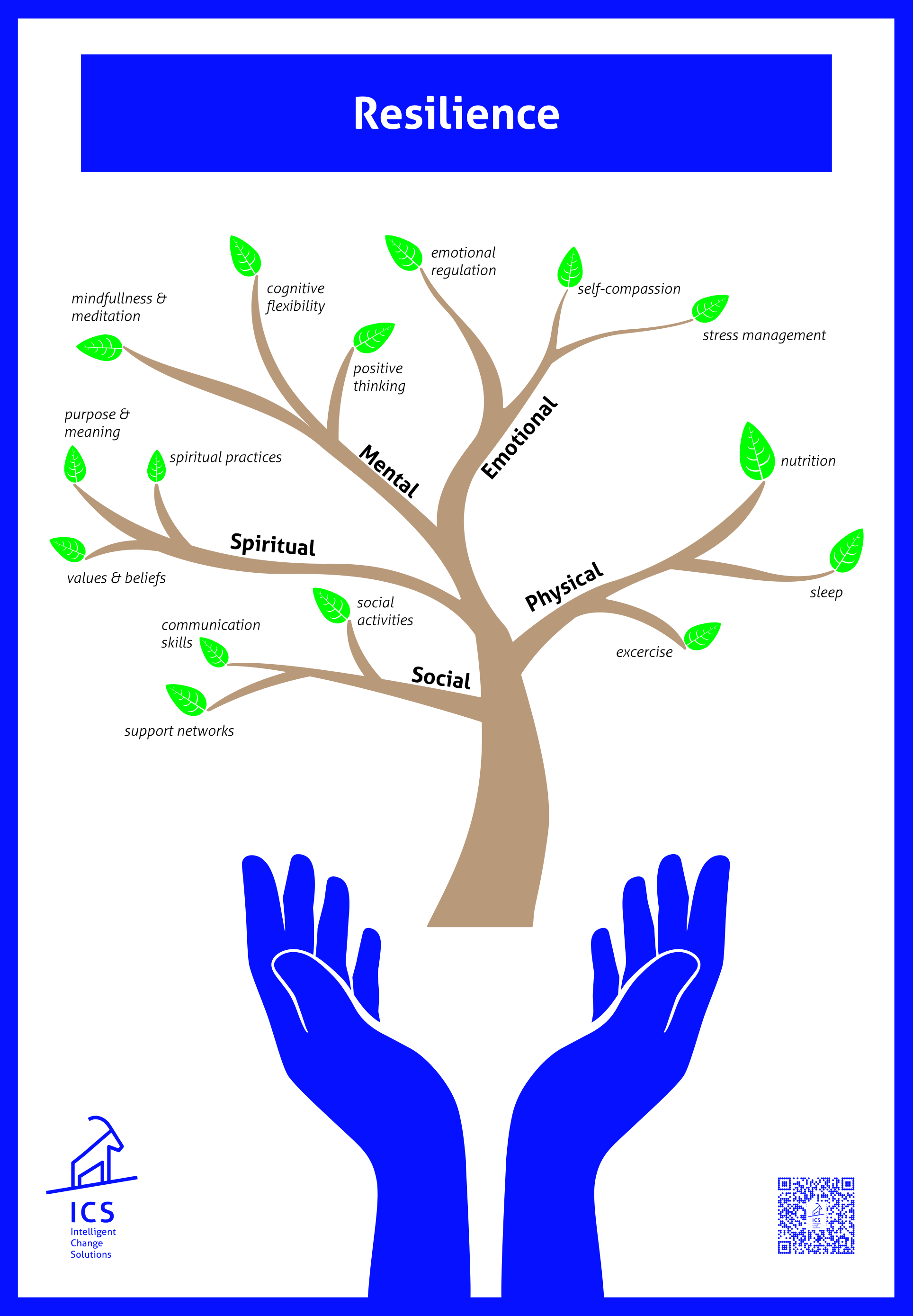
Resilience refers to the ability to return to yourself and your own strength after effort, disappointment, stressful and also painful experiences. Many factors can be used positively in this process: thinking, emotions, the body, social relationships and attitudes towards meaning. The model of these five dimensions helps to view resilience not as something abstract, but to examine it concretely: Where are resources available – and which area currently needs particular attention?
What does resilience mean?
Resilience describes the ability to deal with stress, uncertainty and setbacks in such a way that the capacity to act is maintained or regained. It does not mean always being strong or overcoming crises without emotion, but rather developing a way of dealing with these typically human challenges that leads to orientation, stability and room for action.
Resilience is not a fixed personality trait. It can be deliberately strengthened – mentally, emotionally, physically, socially and through orientation towards meaning and values.
The five dimensions of resilience
1. Mental resilience
Mental resilience describes the ability to consciously perceive thoughts, change perspectives and remain solution-oriented even under pressure. Those who remain cognitively flexible do not react rigidly to stress, but are able to recognize new possibilities for action.
This includes:
cognitive flexibility → searching for and finding new thoughts.
constructive thinking → focusing on solutions, even when they are not yet ideal.
mindfulness and meditation → calming mental cinema and inner noise and arriving in the here and now.
2. Emotional resilience
Emotional resilience means dealing consciously and regulatively with one’s own emotions. It is not about suppressing emotions, but about perceiving them, classifying them and remaining capable of acting.
This includes:
emotion regulation → recognizing and influencing one’s own feelings.
self-compassion → developing a loving, appreciative and forgiving attitude towards oneself.
stress management → creating the right balance between activation and recovery.
3. Physical resilience
The body forms the foundation of psychological resilience. Lack of sleep, lack of movement or permanent exhaustion have a direct impact on concentration, mood and decision-making ability. Physical resilience is therefore not an additional topic, but a central prerequisite for inner stability.
This includes:
nutrition → healthy food in the right quantity.
movement → sport, walking, stretching.
sleep → sufficient sleep of good quality.
4. Social resilience
People do not cope with stress solely from within themselves. Sustainable relationships, good communication and reliable support networks are among the most important protective factors against overload.
This includes:
communication skills → talking to people about what one experiences internally and externally.
social activities → spending time together with people.
support networks → maintaining the closest relationships, in friendship and family.
5. Focus on Meaning and Values
Especially in uncertain or stressful situations, clear orientation helps: What is important to me? What is worth making an effort for? Which values give me direction? This dimension can include spiritual aspects, but does not have to be understood in a religious sense.
This includes:
meaning and significance → using the freedom to give meaning to small and large experiences and encounters.
spiritual or reflective practices → looking at and accepting the bigger picture.
values and beliefs → creating a connection to what is truly important to you.
How the five dimensions interact
The five dimensions are in constant interaction.
An example: chronic lack of sleep is initially a physical issue. At the same time, it can weaken emotional regulation, impair concentration and intensify social conflicts. Conversely, stable relationships, clear values or regular movement can help to cope better with mental and emotional stress and to sleep more deeply and restfully.
Resilience work therefore rarely means starting at only one single point. The decisive question is: Which dimension is currently under particular strain – and which resource can be strengthened? Or also: What would be easiest for me to shape as the next step? Because sometimes even a small crack in the door is enough for the light to become visible.
Use in coaching, training and organizational development
The model of the five dimensions is suitable as a simple framework for reflection and diagnosis.
In coaching, it can help to clarify together with the coachee which area currently needs particular attention and where an effective starting point lies.
In training, it can be used as the basis for self-assessment: Which dimension is well cared for? Where do blind spots arise? Which ideas for more resilience can the group develop?
In team development, the model makes visible whether stress is viewed only individually or whether structural factors also play a role – for example, lack of social support, permanent availability or unclear values → with the aim of either making a difference precisely at these points or shaping a way of dealing with them.
In organizational development, the model reminds us that resilience is not solely an individual task. Organizations also strengthen resilience through framework conditions: realistic workloads, good communication, psychological safety, spaces for breaks and recovery as well as a clear orientation towards meaning and values.
In short
Resilience is more than mental strength. It emerges through the interaction of mind, emotion, body, relationships and meaning. Anyone who wants to strengthen resilience deliberately should therefore not only ask: “How do I remain strong?”, but also: “How do I deal with the fact that I can only be strong if I also clearly acknowledge my weakness?” or “What balance between performance and recovery is good for me?”.