What Is Pacing in Communication?
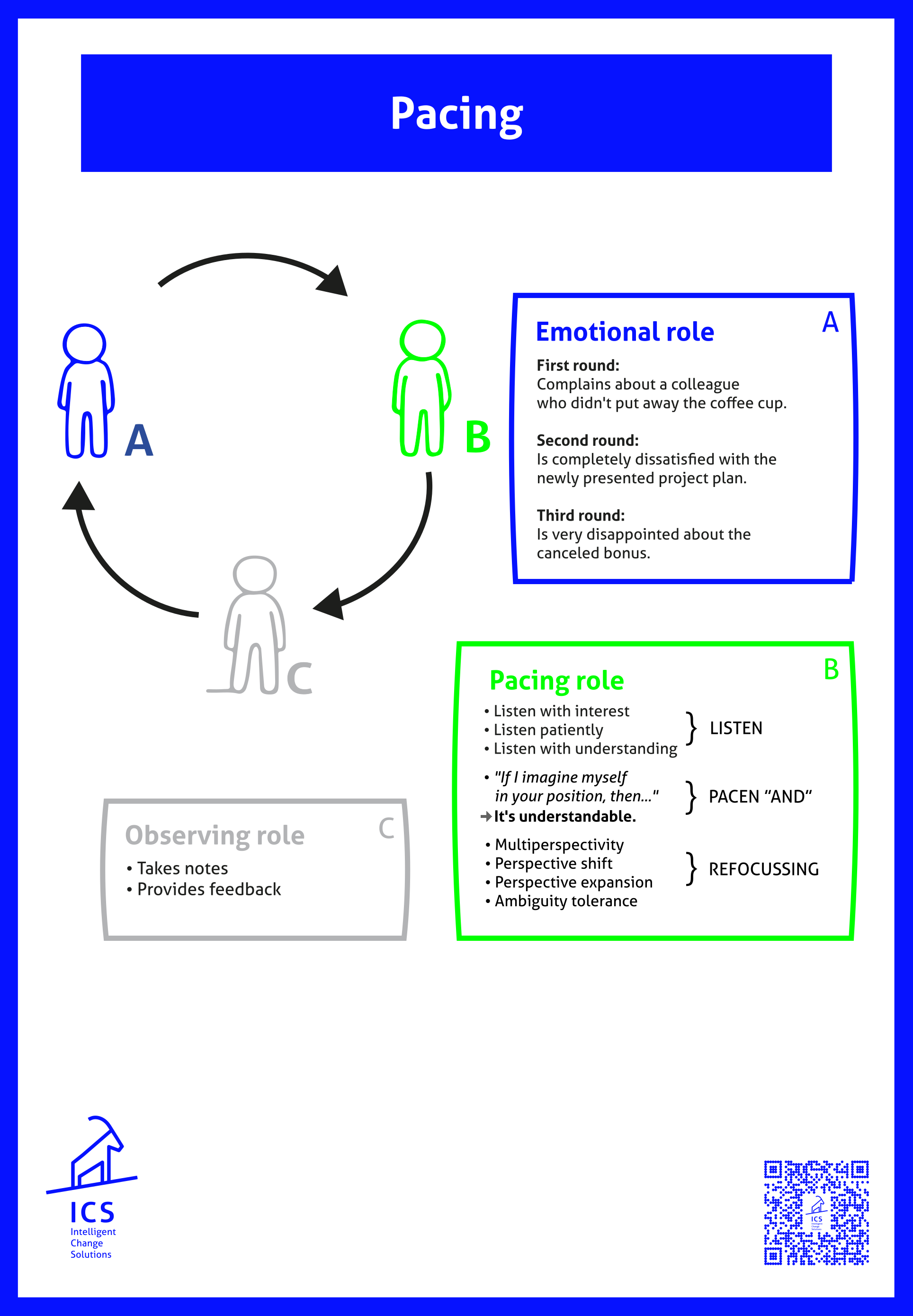
Pacing embodies empathy, a genuine desire to comprehend, and the assumption of competence and goodwill in communication. It involves statements like “If I were in your shoes, I’d probably feel the same way” and “If I follow your logic, I arrive at similar conclusions.” These phrases exemplify the concept of pacing. It is the art of understanding without necessarily agreeing.
Respect First – Alignment Through Dialogue
The primary aim of pacing is twofold: to grasp and acknowledge the other person’s needs and thought processes while concurrently expressing one’s own needs and thought processes in a manner that promotes alignment, so both parties and move towards their shared objective.
It’s important to note that pacing doesn’t entail adopting the other person’s thoughts, opinions, or attitudes outright. Instead, it involves respecting their perspective and presenting one’s own viewpoint as a complementary addition. This approach encourages collaborative problem-solving.
As a communication technique, pacing proves especially valuable when dealing with emotionally charged conversation partners or topics. It serves a dual purpose:
It validates and respects the emotional dimension and its underlying intentions.
It facilitates a broadening of perspectives or a shift in viewpoint on the factual level.
Using pacing in communication
When someone is venting, adopting a confrontational stance, or displaying anger, it’s essential to recognize that, from their perspective, these emotions have a valid cause. Even if you don’t perceive it that way, in their world, it’s a reality.
Step 1: Listen
Consequently, the initial step in pacing is to listen attentively, patiently, and empathetically. This process aims to uncover the root cause and context behind the other person’s emotional state.
Step 2: Pacing
Pacing involves demonstrating an understanding of the other person’s feelings, whether they’re outraged, offended, or hurt. Instead of dismissing their emotions with phrases like “There’s no reason for this,” you respond with empathy, saying, “I understand that you have a valid reason for feeling this way” or “If I were in your shoes, I’d probably feel the same way.” This approach is effective only when it’s genuine and authentic.
Step 3: Shifting Perspectives
After conveying understanding, it becomes crucial to introduce a shift in the current perspective. This transition should never be introduced with a “but” but rather with an “and.” For instance, you might say, “As I listen to you, I can understand why that upsets you. AND at the same time… I wonder if xyz could also be possible… I see other aspects from my point of view… I’d like to explore alternative solutions together.”
The wild-west-analogy for pacing
Gunther Schmidt from the Milton Erickson Institute illustrates pacing with a wild-west-analogy. In a classic wild-west movie, there is usually a sequence where a stagecoach is under attack. The horses go wild, the coachman falls lifeless in the sand, the damsel in distress screams, and they’re all hurtling toward a cliff.
Enter the hero. Instead of confronting the horses head-on and attempting to rationalize them away from the cliff, the hero rides alongside them, picking up the same PACE, sharing their path toward the edge. The hero matches their speed, their pace. Only then does he cautiously leap over and gradually redirect their course.
Translation at the communication level
Matching direction and speed means initially understanding the other person’s situation thoroughly.
“If I were in your situation, I’d likely feel the same way.”
“If I follow this line of thinking, I’d arrive at similar conclusions.”
The leap occurs through the use of the word “AND” (avoiding the use of “but,” which would be equivalent of falling of the horse). The gradual transition following the “and” entails introducing a difference, such as new information or an alternative perspective:
“And… at the same time, I believe…”
“Another facet to consider is…”
“I also sense that, in addition, xyz…”
It’s essential to emphasize that this doesn’t imply your own arguments are superior. Pacing is primarily important for cushioning emotional tension and fostering flexibility within the interaction.