How Stress Arises and Why We Experience It Differently
It is not the situation itself, but our appraisal of it that triggers stress. Lazarus’ model shows how we interpret stimuli, assess our resources and why the way we deal with stress is so important.
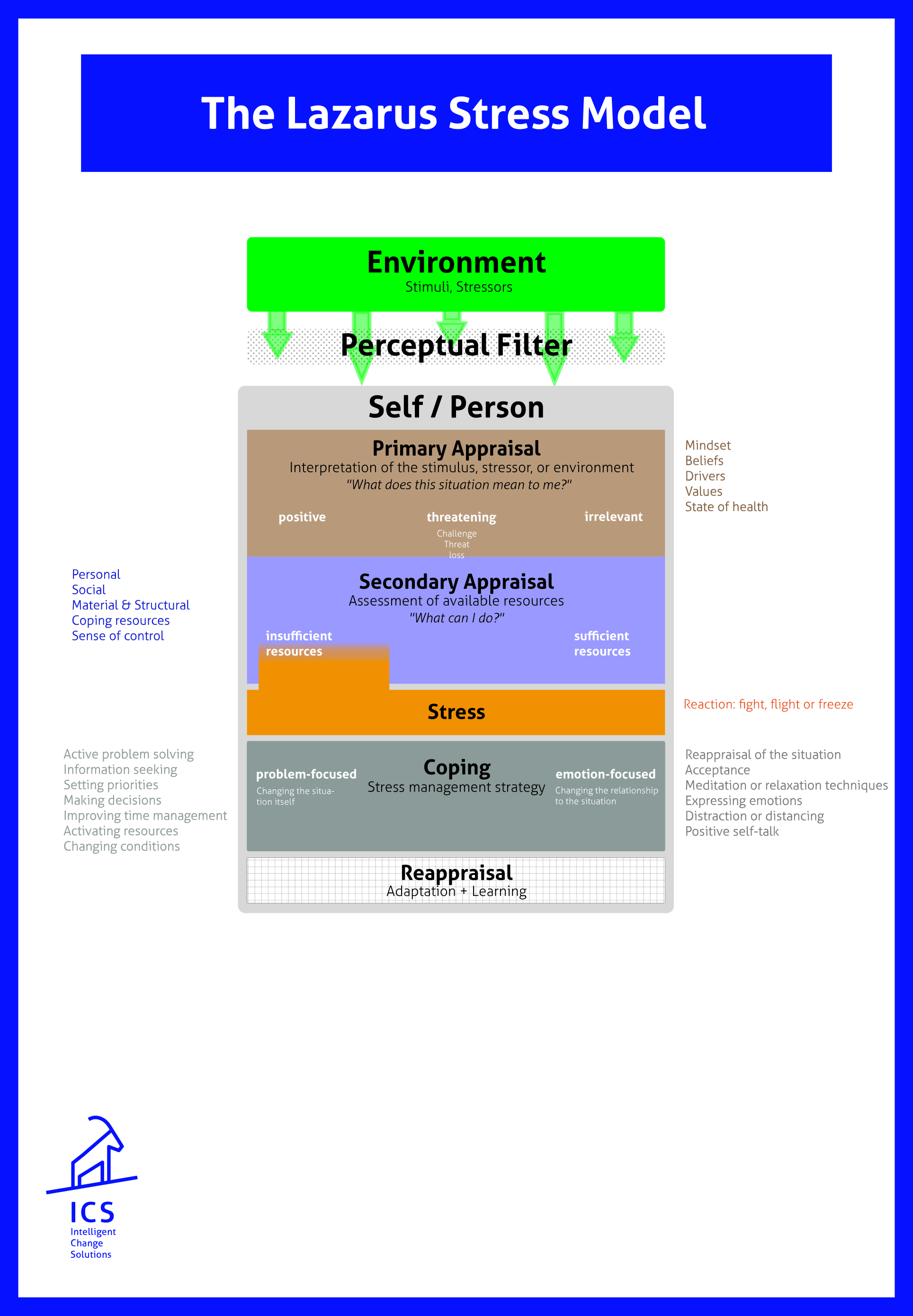
The stress model developed in 1984 by Richard Lazarus together with Susan Folkman describes a cognitive-transactional approach. It explains how stress arises and why people react differently to the same situation. Stress is understood as a dynamic process between the person and their environment.
At the heart of the model is the insight that stress is not caused by the situation itself, but by our appraisal of that situation.
The model helps us understand why some situations are experienced as stressful while others are not, why people deal with pressure differently and how we can actively influence the way we handle stress. Especially in change management, leadership and everyday working life, it provides clear guidance for dealing with strain and pressure.
The Model
The model describes stress as a multi-stage process.
It begins with a stimulus from the environment. This may include demands in everyday work, changes, expectations or uncertainties. However, the crucial point is that these stimuli do not affect us objectively. We perceive them through an individual perception filter.
This perception filter consists of our previous experiences, our values and beliefs, our personal situation and our current state. That is why two people can experience the same situation and still react to it in completely different ways.
Primary Appraisal – “What does this situation mean to me?”
First, we appraise the situation. We classify it as irrelevant, positive or potentially threatening.
Irrelevant: no stress reaction
Positive: for example, as a challenge
Dangerous: as a threat, loss or overload
What matters is not the situation itself, but the meaning it has for us. If we appraise a situation as irrelevant or positive, we can usually deal with it well. If, however, we experience it as threatening, a more intense inner process of coping begins.
Secondary Appraisal – “What can I do?”
In the second step, we assess our resources. We ask ourselves whether we are able to cope with the situation and whether we have the necessary means to deal with it.
Typical questions include:
Do I have enough skills?
Do I have support?
Do I have time, energy or influence?
This is where it becomes clear whether we feel capable of taking action. If we assess our resources as sufficient, we can usually cope with the situation. If not, we feel overwhelmed.
When Does Stress Arise?
Stress only arises when two things come together:
A situation is appraised as stressful or threatening, while our own resources are assessed as insufficient at the same time.
Typical reactions include inner tension, uncertainty, overwhelm or physical stress responses. Automatic patterns such as fight, flight or freeze often follow.
Coping – Dealing with Stress
After the appraisal, active stress management begins. This is known as coping. It involves either changing the situation itself or changing the way we deal with it.
There are two basic forms:
Problem-Focused Coping
Here, the situation is actively influenced. This includes looking for solutions, taking action, setting priorities or organizing support. The aim is to change the situation in concrete terms.
Emotion-Focused Coping
Here, the focus is on the inner response. This may involve accepting the situation, reflecting on it, creating space for relaxation or gaining inner distance. The aim is to stabilize one’s own state.
Reappraisal
After coping, the situation is appraised again. We check whether we now have a better handle on it and whether our perception has changed.
This process is dynamic and often takes place repeatedly, sometimes unconsciously. This is how learning and adaptation occur.
Why the Model Is So Helpful
The model makes clear that stress is subjective and does not arise objectively. What matters is our appraisal and the way we deal with our resources. It shifts the focus from “The situation is the problem” to “How do I deal with it?”
This makes it clear that we can influence how we handle stress.
Practical Application
In Change Processes
The model helps us better understand different reactions to change. It allows us to classify resistance and overwhelm and to focus on existing or missing resources.
Helpful questions include:
How is the situation currently being appraised?
Where does uncertainty or threat arise?
Which resources are missing?
What would increase a sense of safety?
In Leadership
Leaders can learn not only to judge employees by their behavior, but also to take into account how they appraise the situation. At the same time, they can specifically strengthen resources, for example through clarity, support or structure.
Important guiding questions include:
How does the person experience the situation?
What exactly makes it difficult?
What would help them experience it as manageable?
In Teams
The model promotes understanding of different perspectives. It helps teams judge less and understand more. It also supports the joint clarification of demands and resources.
Typical questions include:
Where do we as a team see challenges or threats?
Where do we feel secure, and where not?
Which resources do we have — and which are missing?
How can we support one another?
For Individual Reflection
The model helps us consciously reflect on and actively shape our own way of dealing with stress.
Helpful questions include:
How do I appraise the current situation?
What exactly stresses me about it?
Do I experience the situation as a threat or as a challenge?
Which resources do I have — and which are missing?
What can I do specifically to change the situation?
What can I not change — and how can I deal with it differently?
What would help me regain my ability to act?
The aim is to consciously question one’s own appraisal and recognize possible courses of action.Fazit
Conclusion
Lazarus’ stress model shows that stress is not caused by the world itself, but by our appraisal of the world.
This model helps us understand stress more clearly, classify reactions and remain capable of taking targeted action. Especially in change processes and leadership, this understanding is crucial.
Those who change their appraisals and resources also change the way they deal with stress.