Using the Body with Impact: What Is Problem-Solving Gymnastics?
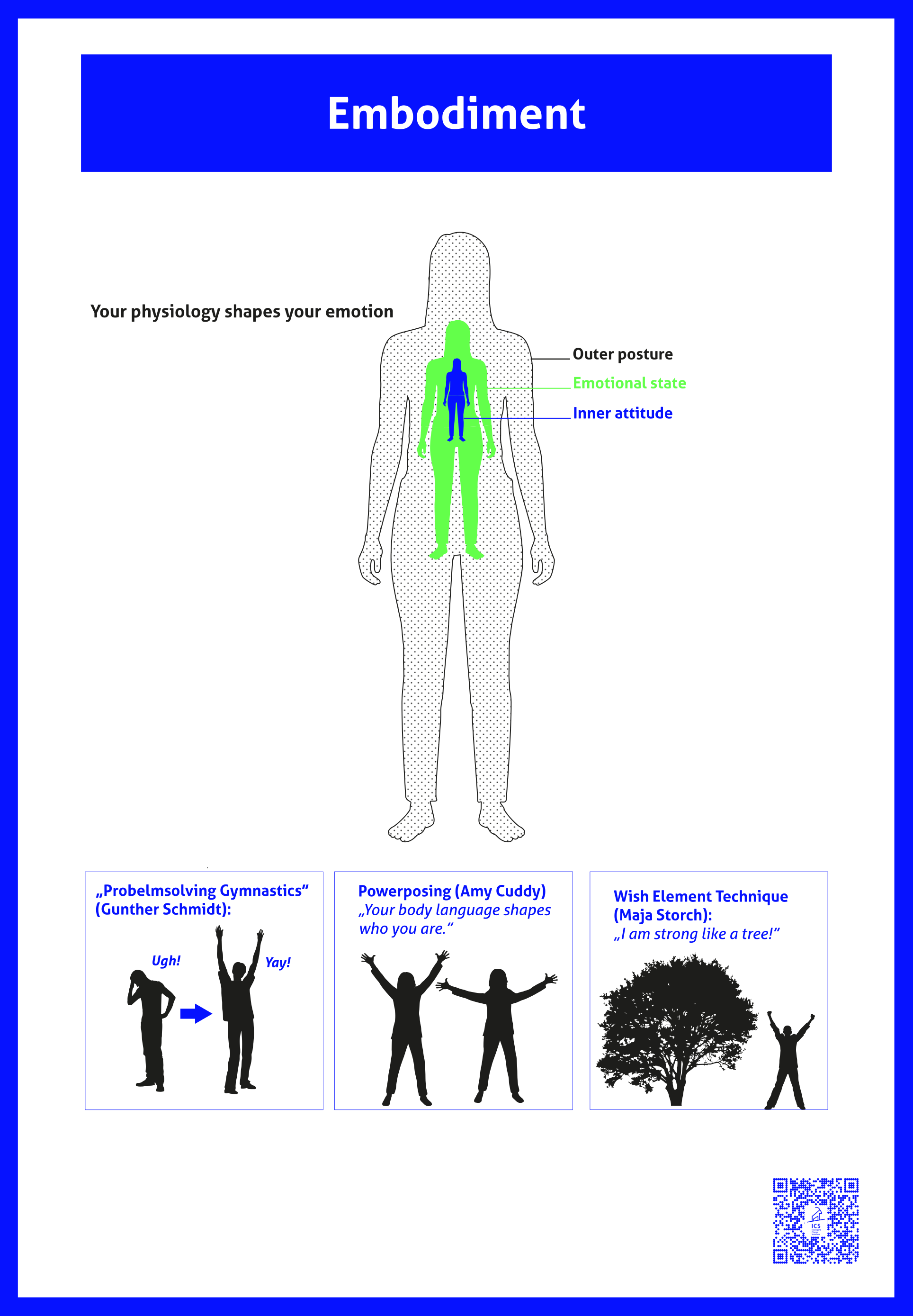
Problem-Solving Gymnastics according to Gunther Schmidt is a fast and direct method that works both through the coach, leader, facilitator or trainer demonstrating the movement and through the coachee, employee or participant trying it out themselves. The conscious change of posture (“Ugh!” vs. “Yay!”) has an immediate effect on the emotional state. This principle is also used, for example, in power posing (Amy Cuddy) and in the Wunschelemente technique developed by Maja Storch.
Methodologically, Problem-Solving Gymnastics can be used very effectively — provided there is good rapport — even without explanation, simply by demonstrating it first (“leading” / “you go first”). For coachees, it is often also very helpful to apply the method consciously, for example as a transfer task.
The Method: Why Words Are Often Not Enough
Human thinking and feeling always take place on many different levels of the brain. The deeper, more emotional and more intuitive the contents of these thinking and feeling processes are, the less clearly they can be put into words or changed through words alone.
How It Works: Body and Brain in Dialogue
Problem-Solving Gymnastics according to Gunther Schmidt is a body-oriented, rapidly effective method for changing one’s emotional state, activating resources, strengthening focus and feeling more appropriate to the given context. It is particularly suitable for coaches, leaders, facilitators and trainers who want to break up stuck emotional or mental states in their settings and release new energy.
From a hypnosystemic perspective, its effectiveness arises from the neural networks that are formed between the body and the limbic levels of the brain. “The way you walk is the way you feel” is one of the phrases Gunther Schmidt frequently repeats in this context.
Related Concepts: Embodiment and Power Posing
Similar approaches can also be found in embodiment work, for example in the work of Maja Storch, and in power posing, as described in Presence: Bring Your Boldest Self to Your Biggest Challenges by Amy Cuddy (2015). The emphasis is on the immediate influence of posture and movement on mental and emotional states.
How the Method Works in Practice
In practical application, the method begins with observing signs of the connection between mood and posture — either in oneself or in others. The next step is to notice the effects of changes in posture. The following examples are intended to give an idea of possible elements. However, it is important to note that these elements are always experienced individually and cannot simply be transferred from one person to another.
1. Powerless vs. Energetic
| Element | Powerless | Energetic |
|---|---|---|
| Posture | Shoulders drooping, back bent, head lowered | Upright posture, sternum slightly lifted, gaze directed straight ahead |
| Movement | Slow, dragging movements | Springy, purposeful movements |
| Breathing | g Shallow, mainly in the chest, barely noticeable | barely noticeable Deep, rhythmic, activating, for example into the belly |
2. Bored vs. Interested
| Element | Bored | Interested |
|---|---|---|
| Posture | Body collapses inward, head supported or tilted to the side | Neutral to slightly forward-leaning posture, open chest, alert gaze |
| Movement | Sluggish, little movement, monotonous gestures | Lively gestures, small approving movements, for example nodding |
| Breathing | Slow, sighing or yawning | Lively, steady, sometimes slightly accelerated due to anticipation |
3. Anxious vs. Confident
| Element | Anxious | Confident |
|---|---|---|
| Posture | Contracted, shoulders forward, arms close to the body, gaze directed downward | Upright, expansive posture, arms possibly open, gaze directed forward |
| Movement | Hesitant, retreating, avoidant | Clear, purposeful, moving into action |
| Breathing | Fast, shallow, possibly interrupted | Deep, steady, stabilising |
Practical Tips for Use in Coaching
Clarify the frame: Check in advance whether physical exercises are appropriate and feel right for the coachee. Introduce them sensitively if needed.
Demonstrate instead of explaining: The method often works best through the principle of “you go first” — that is, by actively demonstrating it.
Exaggerate the movement: An exaggerated demonstration, for example an intentionally amplified “Yay!” posture, helps make the effect clearly noticeable.
Use contrasts: Let the coachee consciously move through contrasts such as “powerless vs. energetic” so that the differences become tangible.
Mirror body language: Pick up on the coachee’s movements and vary or mirror them deliberately to increase awareness.
Connect it with breathing: Integrate conscious breathing, for example “breathe into your strength” or “breathe out into relaxation.”
Support transfer: Suggest the exercise as a mini-ritual for everyday life, for example before important meetings or difficult conversations.
Use it creatively: The exercise can also be used with humour, playfulness or music, depending on the setting and target group.
Include reflection: After the exercise, pause consciously and ask: “What did you notice?” or “What has changed?”
Scale it: Depending on the situation, the exercise can be done standing, sitting or even as a mini-version at the desk.
Sources and Further Reading
Gunther Schmidt, the founder of hypnosystemics, offers an initial insight on his Website and deeper reflections in his blog posts.
Amy Cuddy – Presence: Bring Your Boldest Self to Your Biggest Challenges (Posture, Embodiment, Expression)