How Stress Changes the Way We Think and Act
When we are under stress, the brain shifts into a different operating mode. Emotions take over and clear thinking becomes more difficult.
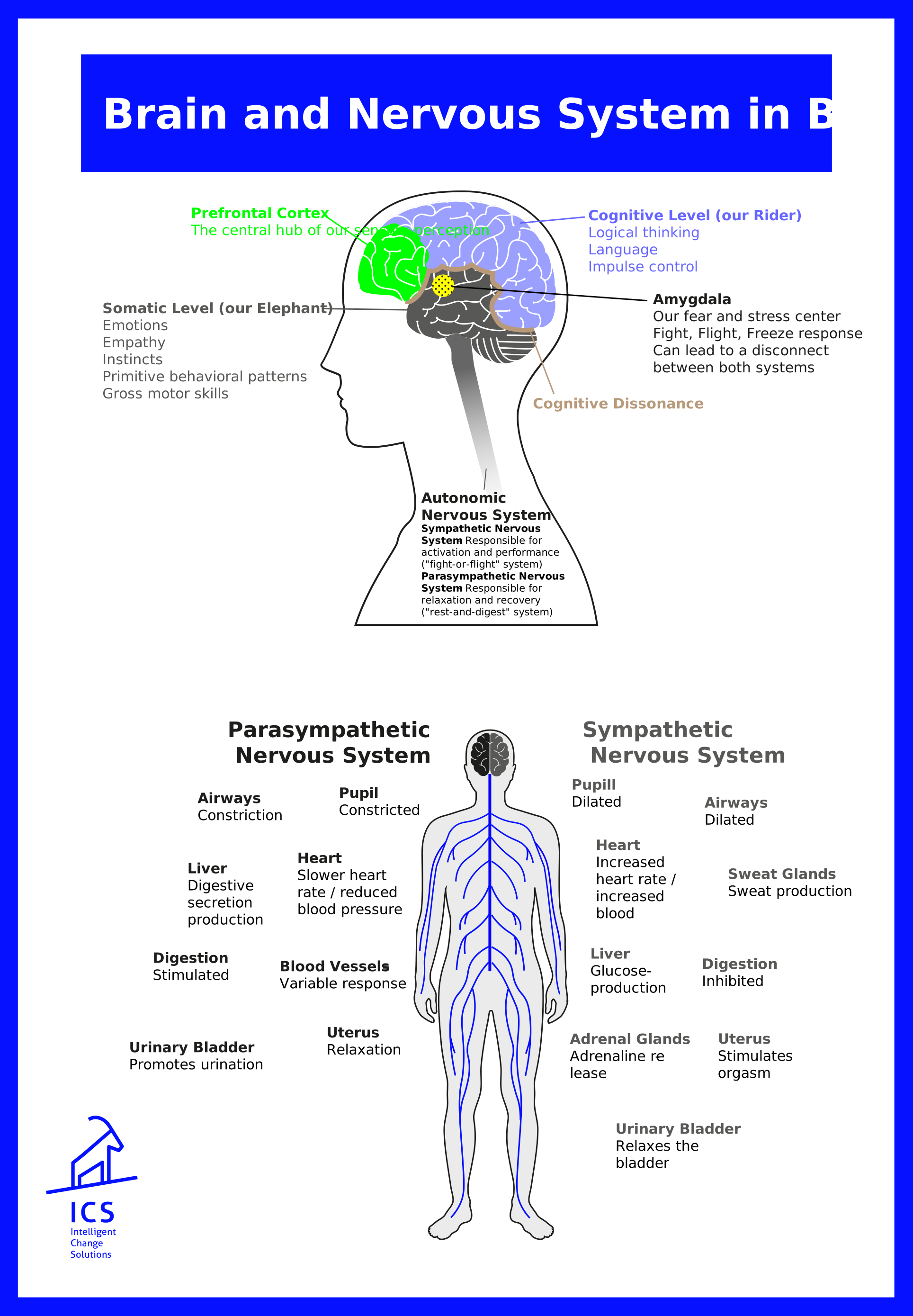
The Brain Under Stress model explains what happens in the brain during stressful situations and why we often think, feel, and behave differently than usual when under pressure.
It combines neurobiological principles with an easy-to-understand metaphor: the interaction between the cognitive level (the “Rider”) and the somatic level (the “Elephant”).
The goal is to better understand stress reactions and develop a more conscious way of responding to them.
The Model: The Interaction Between Thinking and Reaction
The model distinguishes between two closely connected systems: the cognitive level and the somatic level.
Cognitive Level (The Rider)
The cognitive level represents our conscious, rational thinking. This is where logical analysis takes place, language is controlled, actions are planned and impulses are regulated. Central to this is the prefrontal cortex, which acts as a control center and coordinates perception and decision-making.
Somatic Level (The Elephant)
The somatic level comprises our physical and emotional responses. These include emotions, instincts, empathy, as well as more archaic patterns of behavior and gross motor responses. This level reacts quickly, automatically and often unconsciously.
Ideally, both levels work together. The “rider” guides the “elephant.” Under stress, however, this interaction becomes unbalanced.
The Role of the Prefrontal Cortex
The prefrontal cortex is the part of our brain responsible for conscious, reflective, and purposeful action. It enables us to control impulses, regulate emotions, weigh options, make decisions, and shift perspectives.
In this way, it acts as a central “control center” between thought and action.
What happens in the brain under stress?
Under stress, the function of the prefrontal cortex is impaired. This has a direct impact on our behavior: impulse control decreases, we react more quickly and emotionally, clear thinking becomes more difficult, and our language becomes less precise. At the same time, we are more likely to fall back on simple or familiar patterns of behavior.
A key factor here is energy balance. The prefrontal cortex depends on energy to function effectively. After a demanding day or during periods of high strain, our self-control decreases. We become irritable more quickly, and it becomes harder to act “rationally.” The likelihood of impulsive behavior increases significantly.
At the same time, the amygdala — the central fear and stress center — takes over more control. We then tend to react automatically rather than reflectively. Typical patterns are fight, flight or freeze.
In this state, the two levels become disconnected: the “rider” loses control over the “elephant.” Thinking, feeling and acting begin to drift apart.
Cognitive Dissonance Under Stress
A central effect of this disconnection is cognitive dissonance. This means that thinking, feeling and acting are no longer aligned. People react more impulsively or irrationally and make decisions with less reflection.
This explains why even experienced leaders may act differently under pressure than they do in stable situations.
The Role of the Autonomic Nervous System
In addition to cognitive processes, the autonomic nervous system plays a central role. It regulates our internal balance and controls activation and relaxation.
Two systems work together here:
the sympathetic nervous system, which activates the body and prepares it for performance, and
the parasympathetic nervous system, which supports relaxation and recovery.
Under stress, this balance is disrupted: the sympathetic nervous system dominates, and the body remains in a constant state of alert. In the long term, this can lead to exhaustion, reduced performance and impaired decision-making quality.
Why This Model Is So Helpful
The model explains why people respond differently under pressure and why purely rational arguments often fail in stressful situations.
It highlights the importance of emotional and physiological processes and creates greater understanding — both for ourselves and for others.
Practical Applications
In Change Processes
The model helps leaders and organizations better understand resistance, emotional reactions, and feelings of overwhelm during change.
The focus shifts from purely communicating content toward creating safety, orientation, and stability.
In Leadership
Leaders become better equipped to recognize stress responses in employees and manage pressure situations more consciously.
Leadership therefore extends beyond content and task management.
In Teams
The model helps teams understand behavioral dynamics under pressure.
Instead of personalizing behavior (“That person is difficult”), teams gain a deeper understanding of stress reactions and their underlying causes.
For Personal Reflection
The model supports people in recognizing their own stress patterns and responding more consciously.
Helpful reflection questions include:
How do I notice that I am stressed?
Do I tend to respond with fight, flight, or freeze?
When do I lose access to clear thinking?
What helps me regain balance?
What helps my nervous system return to a calm and regulated state?
The goal is to strengthen self-regulation and move from automatic reactions toward intentional action.
Strategies for Stress Regulation: Returning to Balance
o move out of stress mode and restore the connection between the cognitive and somatic levels, people use different strategies.
In general, two forms can be distinguished:
Problem-Focused Coping
This is about actively doing something to change the situation or reduce stress. This may include looking for solutions, having conversations or releasing tension through movement.
The aim is to actively influence the situation or reduce built-up energy.
Emotion-Focused Coping
Here, the focus is on regulating the inner state. This includes relaxation, acceptance, reflection, mindfulness or consciously creating inner distance.
The aim is to calm the nervous system and restore emotional stability.
Combining Both Approaches
Effective stress regulation rarely depends on only one strategy.
The key is choosing the right approach for the situation.
If the situation can be changed → problem-focused coping is often helpful.
If the situation cannot be changed → emotion-focused coping becomes more important.
Long-term resilience develops through the ability to move flexibly between both approaches.
Ultimately, both strategies aim to regulate the autonomic nervous system and reconnect emotion (the Elephant) with cognition (the Rider).
Only when the internal state becomes more stable can the prefrontal cortex regain its ability to think clearly and guide behavior effectively.
Conclusion
The “Brain Under Stress” model combines neurobiological knowledge with practical applicability. It shows why stress has such a strong influence on our behavior, how thinking and emotions can drift apart, and why regulation is the basis for effective action.
This understanding is particularly important in leadership and change contexts, because people do not change on a purely cognitive level, but always on an emotional and physical level as well.